Today was extremely hot, so instead of going to a provincial park, we decided to visit the Waterloo Region Museum, which offers free admission on Canada Day every year.
Although I have been to the museum several times before, I spent more time reading the exhibit descriptions today. The stories of local farmers, workers, entrepreneurs, and pioneers caught my attention. I was impressed by the pioneers’ spirit and all the effort they put into building their communities.
Conestoga Wagon
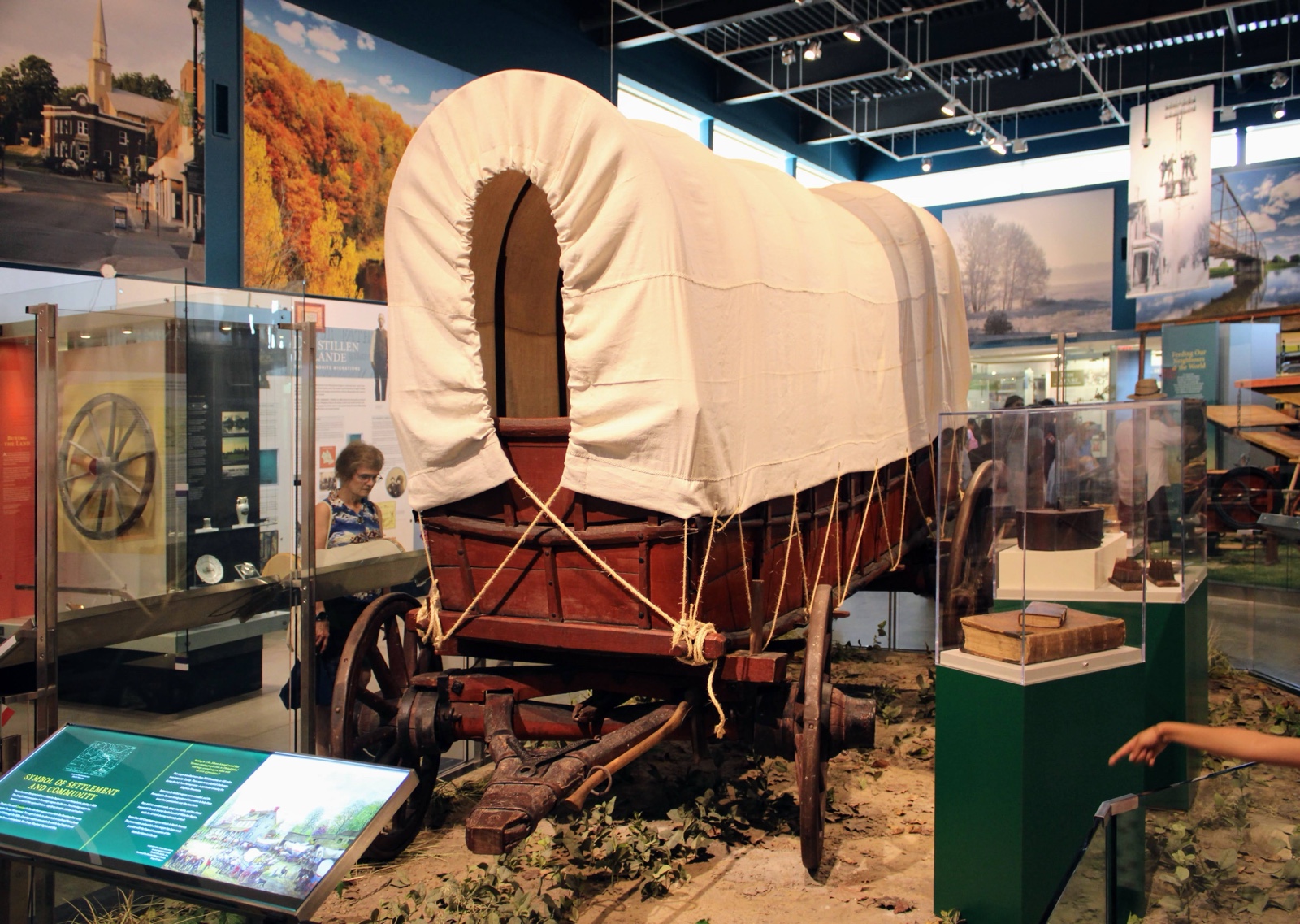
The earliest non-Aboriginal settlers in Waterloo Region came from Pennsylvania, starting in 1800. They brought their possessions in Conestoga wagons like this one. The Conestoga wagon has become a symbol of this region of Ontario – signifying strength, stability and tradition.
The use of the word Conestoga to describe these wagons comes from the Conestoga River valley in Lancaster County, Pennsylvania. This wagon is similar to others made in southeast Pennsylvania from about 1770 through the 1850s. Conestoga wagons were originally used to haul freight to and from farms in Pennsylvania, New Jersey, Maryland, Virginia and Ohio.
This wagon travelled more than 700 kilometres, or 435 miles from Lancaster County. There were many physical challenges during the trip from Pennsylvania – in particular crossing the Allegheny Mountains. Some heavily loaded wagons were unloaded, and the Pennsylvania-German immigrants paid teamsters to help them move their possessions over the mountains. Poor and non-existent roads, steep river banks, and the almost impassable Beverly Swamp located south of Waterloo Region, made the 10 week journey extremely difficult. Fewer than 150 Conestoga wagons remain in North America.
Threshing Machine
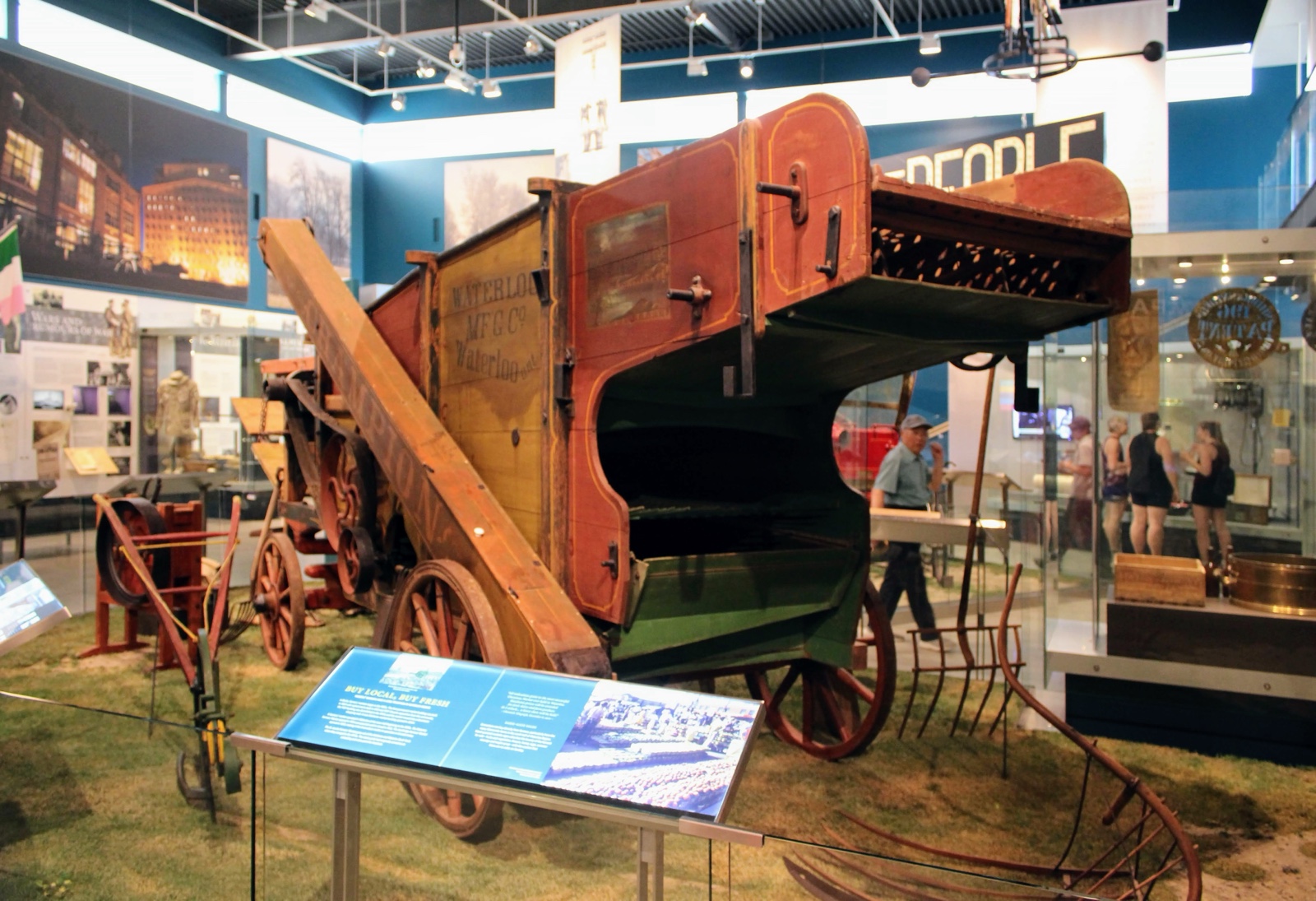
Today large combine harvesters do the work of threshing machines and other farm machinery. In the past, specialized threshing machines were used to separate just about any seed or kernel such as wheat, soybeans, barley and clover from their husks and straw.
This threshing machine was powered by a portable steam engine via a long, flat belt. Wooden threshing machines were phased out by the 1920s and replaced by machines made of galvanized steel. By the 1930s, gas tractors had replaced steam engines as power sources.
Threshing machines were often owned by a group of farmers, or by one operator who rented out his machine and crew during harvest time.
Beck Truck
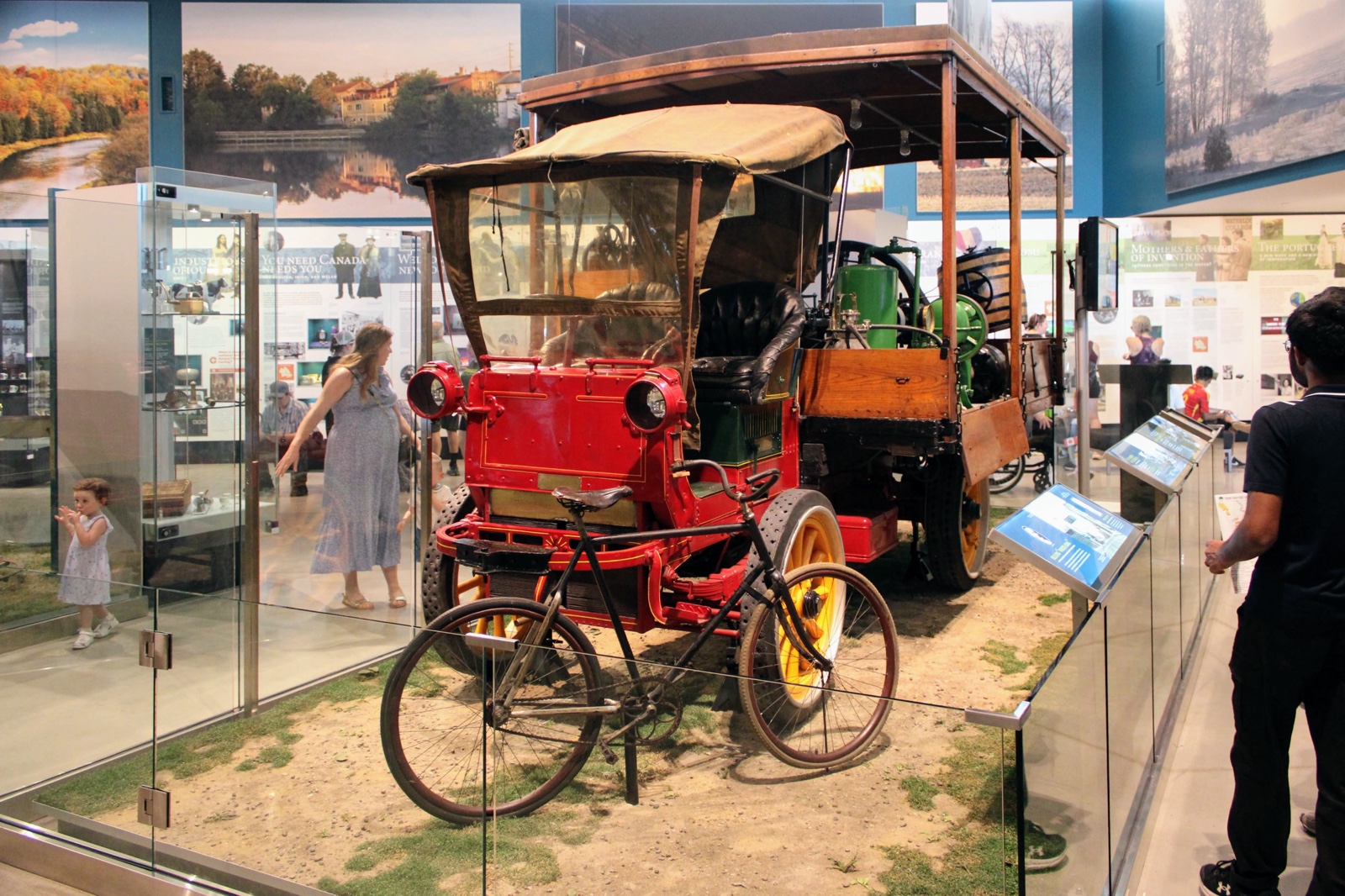
Daniel Detweiler rode across the local countryside on this bicycle in the early 1900s – meeting with farmers to convince them to allow the power company to run lines to bring electricity from Niagara Falls to Waterloo Region. It was not always an easy sell. Many people weren’t sure just what electricity was… you rarely saw it, you couldn’t smell it and it was not a good idea to touch it!
Named after Sir Adam Beck, the Beck Truck or Beck’s Circus, traveled to county fairs and public events in 1912, demonstrating the marvels of electrically powered appliances to a largely rural audience. Equipment on the truck included: a motor and lineshaft, a pump jack
a wringer washer, a grain grinder, a water pump, a butter churn, a milking machine
The message was that the future was coming to your home and that future was brought to you by electricity.
Farmers’ Market
In Berlin, farmers’ markets began in the 1830s. The first permanent market building was built in 1869 with replacements built in 1872 and 1907. Despite opposition from the community, the 1907 building was demolished in the 1970s and the market moved into a downtown shopping mall. A new Kitchener market building opened in 2004.
A farmers’ market operated in Waterloo at the town hall beginning in the 1870s. The Waterloo Farmers’ Market opened in 1910 and operated until it closed in 1965. The Cambridge Farmers’ Market opened in 1830, making it the third oldest market in operation in Canada today.
The St. Jacobs Farmers’ Market grew out of the Kitchener and Waterloo Stock Yards when they merged in the 1970s. The stock yards had originally served as an unloading and sales point for livestock.
Hydro Electricity
By the late 1800s, a number of cities and towns had electric lights and power by using small local generators. But it was not practical to electrify whole communities.
Hydro electricity changed the scale of everything.
Niagara Falls was a huge potential source of electrical power.
But how to get that power to distant regions like Waterloo?
In 1906, the Hydro-Electric Power Commission was created.
Its first project was to build 110,000 volt transmission lines from Niagara Falls to southwestern Ontario municipalities.
As more communities in southern Ontario connected to the electrical hydro system, more and more power lines and power poles appeared on the horizon. The linemen also appeared: a glamorous new profession skilled in the handling of this mysterious power.
Insurance Companies
The destruction of homes, businesses and farms by fire was a constant threat in the 1800s before municipal water service and motorized fire trucks made fighting fires easier.
Insurance companies developed as a way to offer assistance to your family, home, and business in the event of fire or other accidents, and provide for you and your family in case of injury or death.
As Waterloo Region grew so too did the number of service industries, including the insurance industry. Gore District Mutual Fire Insurance Company – Canada’s oldest continually operating mutual fire insurance company – opened in 1839, in Galt (Cambridge).
Other fire insurance companies followed, organized on the mutual principal, where the company’s financial capital belonged to policyholders instead of shareholders. In 1868 the mutual principal was applied to life assurance for the first time in Canada, at the newly created Ontario Mutual Life Assurance Company in Waterloo.
Through the latter half of the 1800s many more insurance companies were founded, clustered in Waterloo – leading to the nickname the Hartford of Canada. This referred to the American city which at one time was home to many insurance companies and known as The Insurance Capital of the World. Today the insurance industry employs more than 7,000 people in Waterloo Region.


Leave a Reply